Friday, February 21, 2014

Elbrus Race 2014 Tentative Schedule Posted

I recently discussed the Elbrus Race 2014 Schedule with the organizer. It's great to see the schedule up so early. Here's the itinerary as posted on the website [CLICK HERE].

IX international Elbrus Race program :

DateDaysDay's program
06.09.2014day 01Flight arrival to Min Vody. Transfer to Baksan Valley, Azau station. Accommodation in the Hotel Elba.
07.09.2014day 02Acclimatization walking nearby. Accommodation in the Hotel Elba.
08.09.2014day 03Transfer to Azau lift station. The opening of the competition. Going up to refuge "Barrels" ~3710m. Night at refuge "Barrels"
09.09.2014day04Qualifying speed climb from Barrels hut to the Pastukov rocks, 4800 m.
10.09.2014day 05
(full moon at 15:00 pm)
Relax day. Night at the refuge "Barrels"
11.09.2014day 06Speed Climb of Mt. Elbrus West 5642 m. "Classic" from hut Barrels (3710) & "Extreme" from Azau 2400m Descent from Barrels to the Valley
12.09.2014day 07spare day for the Race or Awards Ceremony at the morning & The farewell party at the evening
13.09.2014day 08Transfer to airport. Flight from Min Vody..

The organizer asked for my opinion about the sensitivity of doing the race on the 11th (9/11) and whether we should do it on the 12th. I replied that if we did it on the 12th we should extend the itinerary to allow for a run on the 13th in case of bad weather. Otherwise we could do a memorial service on the 11th before the run and then commemorate wold brotherhood and cooperation with the International Elbrus Race.

Race Organizer Nik and I in the van on the way to the Tram Station
How do you feel about this issue? Should we go ahead or wait a day? I'll pass on your thoughts to the organizer.

Tuesday, February 4, 2014

Elbrus Race Treadmill Training Example

After my article about Treadmill Training Guidelines, I thought it would be a good idea to include one of my own treadmill training sessions as an example. Yesterday I ran outside. It was cold and windy, especially on the return trip. I went a little over 2 miles up the road and turned around. I tried to stay consistent in my speed each way, slower up and faster down. We got over 3' of new snow in Summit County Colorado last week, and it's packing down slowly. Though my favorite route on Keystone Gulch Road is often used by snowcat and snowmobiles for the resort employees and Ski Patrol at the resort, their tracks weren't all that solid yet. I was leaving 3-6" deep tracks in the snow, with my toes digging in quite a bit on the push-off. It was made a bit worse because yesterday morning I did a high volume deadlift workout with 10 sets of 10 for my working sets, followed by 6 sets of 10 assisted pullups. I really felt my glutes while running.

Trail Running in loose snow is a heck of a workout
Today I planned on a treadmill workout. I planned on averaging over 1000 VAM over the course of the workout. I chose 28% elevation and cruised along gently over the first 20 minutes working my way up past 2.0 MPH. Then I did some long intervals at 3.0 mph. Finally I felt hot enough that I did 6 intervals of 1:00 at 4.0 MPH with 1:00 at 2.0 MPH rest. At the end of that I did a couple of minutes at 2.0 MPH and 5 or so minutes at 3.0 MPH, 2.0 MPH to rest, and then one more interval at 4.0 MPH. I spent the remainder of the 64 minutes at 3.0 MP

Movescount reporting from my Suunto Ambit 2 S showing obvious intervals
I was shooting for 3500' on the display, though I know that the NordicTrack Incline Treadmills under-report the elevation stats as you increase the elevation. I have mentioned this a time or two or more in various blog and Facebook posts. At 3500' of elevation I shut down the treadmill and got off to rest, keeping the watch going for a few minutes to record my recovery. I think it's interesting to see how long my body takes to slow down the heart rate depending on my interval volume. Note too that this treadmill sits at a tad over 9300' in elevation.

NordicTrack Incline Treadmill Display after my interval training
I used my Incline Treadmill Calculator CLICK HERE to run the numbers from the console. They were right on with my plan. It's kind of fun to do complicated time and distance and speed math while cranking along at over 160 BPM heart rate and get your VAM goal pretty much right on.

My Incline Treadmill Calculator Shows my Elevation Gain and VAM
Here are the stats in text format:
Time: 64:27
Distance: 2.578
Incline: 28%
Elevation Gain: 3811.32'
Average MPH: 2.4
Average Pace: 25:00
Vertical/Hour: 3548'
Vertical/Minute: 59.14'
VAM: 1081.5
In the context of Elbrus Race, that is roughly equivalent to doing a one hour Qualifier. Though there is no award given for the Qualifier, that's definitely good enough to place. In the context of training in Colorado that's good enough for a one hour Grays or Quandary, both of which I've done in 1:30. My intermediate goal this summer is to beat 1:20 for both.

If you want to make the jump to doing VAM greater than 1000 the treadmill is a reasonably safe environment and forces you to keep your foot turnover rate high enough. You can also shoot to improve your steep vertical "running" technique. At 28% and 4.0 mph and a foot-strike cadence over 160 (I actually counted during my intervals) your heels never touch the belt. I wore New Balance minimalist shoes for this workout to improve my plantar strength. I have worn them on my Mount Royal hill-climbs, but have yet to wear them on Quandary or Grays.

So that's probably a lot more than you needed to know. Share your thoughts with me about how you could incorporate this type of training into your program.

Monday, January 27, 2014

Elbrus Race Treadmill Training Guidelines

Calculate your training paces for an incline treadmill based on VAM

VAM is the Vertical Ascent in Meters per hour. For the Qualifier, Classic and Extreme Races, a 1000 VAM will get you a winning finish, based on current course records. A VAM of 600 will get you a Top Ten finish in these events. 

25 minutes at 36% training for Elbrus Race. Later that day I did run/walk intervals at 12%

I put together a spreadsheet showing the VAM for a variety of speeds and inclines on a treadmill. The left-most column is the % of Elevation Incline, which for most treadmills adjusts up to 15%. Remember that this is the percentage of a mile that you would be going upward at that angle. Example: 10% incline would get you 528' higher at the end of a mile. 40% incline would get you 2112' higher at the end of a mile. That's almost a half mile per mile. Treadmills by Freemotion/Nordictrack and a few others will go that steep.

The row at the top is the VAM, from 200 to 1000. For Elbrus Race training that's generally close enough. Notice that at 3% you have to be going really fast to get a VAM over 400. When you get to 6% it's a bit more real, though most people who run on treadmills would be pretty hard pressed to be doing 6:00 miles (10 MPH) to get in their 1000 VAM.

There's also great value in running outside in the snow in spikes at 9% average grade at altitude
For those without access to a steep incline treadmill, going 4 MPH at 15% is the best way to get in your 1000 VAM. It's not sports-specific to the Elbrus Race, but it's a great workout. If you want to be training in a more specific manner, you'll have to get onto an incline treadmill at 30% or greater and do your steady state cardio at 2 MPH and keep that up with a low heart rate for a couple hours at a time.


% Incline/VAM2004006008001000
34.148.2812.4316.5720.71
62.074.146.218.2810.36
91.382.764.145.526.90
121.042.073.114.145.18
150.831.662.493.314.14
180.691.382.072.763.45
210.591.181.782.372.96
240.521.041.552.072.59
270.460.921.381.842.30
300.410.831.241.662.07
330.380.751.131.511.88
360.350.691.041.381.73
390.320.640.961.271.59
400.310.620.931.241.55
Top 10
Record

Tuesday, December 31, 2013

Goal Setting

I've always had a passion for goal setting, even as a young child. For me, there's nothing like the satisfaction of crossing something really difficult off my list. In the last few days, I've had more than a few friends ask me about my goal setting methods, so I thought I'd make it the subject of my post today.


I want to clarify first, that goals don't have to be about physical achievement alone. My own yearly list is a spattering of spiritual, physical and intellectual goals, as well as goals we've set as a family unit. I know every person is different, but for me, achieving my goals has more to do with proper planning/preparation and less to do with the difficulty of the goal. I set large, yearly goals with smaller benchmarks to keep me on track. In addition, I also set weekly goals aimed at reaching the next benchmark. When I set a goal, I follow the 'SMART' method (I'm not sure of the original author):
S- Specific
M- Measurable
A- Attainable
R- Realistic
T- Timely (include a specific deadline)

For the most part, it's been a bit of a trial and error process. Saying that you'd like to eat healthier is well intentioned, but how do you know when your goal has been met? To make the goal more specific, your smaller weekly goals can include something like, this: In bed by 9pm, replace all sugary drinks with water etc. This specificity makes it much easier to measure your success; either you were in bed by 9pm, or you weren't. Simple.

Attainable goals can be hard to decipher, and this is the area where some of my friends have experienced frustration. This is where your imagination comes into play, and some reflection and meditation may be in order. Remember, that if you're setting a large goal, it will be necessary to set smaller milestone goals to get you there one step at a time. You will be amazed at what you can accomplish if you take it one step at a time. It can also be very encouraging to have evidence of your progress. Inexperience can be intimidating, but remember that those with experience are usually very willing and excited to share their knowledge. Never be afraid to ask for help and opinions.

As you get into the habit of setting and attaining goals, you will discover that you are capable of more than you ever imagined, but you will also find your limitations. Don't let that be a discouragement, but a nudge in a different direction. Make sure the goal is realistic, based on your finances/family responsibilities and take into account any physical restrictions. Personally, as a rule of thumb, I think of something really hard that I should be able to achieve if I work my derriere off, and then up the ante again until I have one foot in crazy. But that's just me.

All of your goals should have a specific timetable, even if it's purely a new year's resolution. You need to have a deadline that will keep you from hitting the snooze bar at 5am. Believe me, if you're not fully committed, that bed gets comfier with each day that passes in those dreadful first two weeks. And they ARE dreadful. Tell yourself before you go to bed that your workout is non-negotiable, I've even been known to lay in bed at night and repeat, "I will wake up with my alarm, I WILL wake up..."

Establish a routine until it becomes habit. Right after I had an emergency delivery with my third child, my body was a mess. Some days, working out was just impossibly painful. On the days that I needed to rest, I still went through the motions of getting my workout gear together and going to the gym, but I would sit in the sauna or hot tub instead of working out. I knew that I had to keep the habit of going to the gym or it would be easy to falter.

On failure... there will be goals that you do not reach. Let yourself be upset. Learn from your mistakes, but never let them drag you down. If you're looking for a reason to quit, you'll easily find one and no one will stop you. Take control. Focus on the positives instead of dwelling on the negatives. Use failures as fuel for your next endeavor or even another try at the same goal. Remember to be somewhat flexible. Life happens. Injuries happen. Family emergencies happen. This is not failure, but merely postponement. If you set your lifetime goals higher, then putting off a race to take care of responsibilities is not a setback, but a step in a more eternal direction.

I do not profess to be any kind of a professional, but hopefully these few tips should get you started in the right direction for the new year! Give yourself the chance to be surprised by your own strength.


Thursday, November 21, 2013

Winter Trailrunning Training

One of my favorite training activities is trailrunning on snow. In freezing weather it's probably one of the most directly sport-specific ways to train for an event like Elbrus Race. Footing on the snow can be difficult with reduced traction on ice or deep loose snow. Running up and down hills in these conditions is great training.


From my own experience Winter trailrunning will be done at a somewhat slower pace than on smoother gravel or dirt trails. That depends on the surface of course. Some of my fastest Quandary (Colorado Fourteener) ascents were done on mostly firmly packed snow. Something that you can do on snow that you can't do on more solid surfaces is churning uphill with your feet cranking away in circles while you barely move up a steep slope. It feels a lot like riding a mountain bike uphill with your feet spinning at a 100 rpm cadence while barely making forward progress.


I usually wear spiked running shoes. I've added 3/8" #6 hex head sheet metal screws to the bottom of some Hoka One One Mafate WP (waterproof) and a pair of Hoka One One Stinson Evo. The former have about 50 miles on them, and the latter had about 240 miles on them when I spiked them. I have a pair of Salomon Spikecross CS that are a more traditional style running shoe with solid lugs and embedded carbon steel spikes. These shoes have been pretty good in the dry snow of Quandary and up the Gulch Road, but the last time I did Mount Royal in melting slush they leaked horribly and I don't know if that was coming in through the top or through leaking seams that need to be sealed. I also use a pair of Pearl Izumi Trail N2 that are not spiked. If the traction and ice is an issue I can wear microspikes with them.


I have a few different layering systems I use, including Windpro front tights and looser pants style tights, normally without baselayers unless it's below zero. On top I normally wear a baselayer top, possibly two thin ones, and a hybrid fleece/softshell jacket. I wear a thin running beanie with a baseball cap on my head and on my hands I wear shell gloves, fleece running gloves, or insulated bike gloves depending on the temperature and wind.


I have been running in the winter for about five years now, almost all at altitude in Summit County Colorado, near the ski resorts of Keystone and Breckenridge as well as the Fourteeners in the area, Grays, Torreys, and Quandary. It's an excellent way to get in shape for high peaks and I'm sure it was instrumental in my one-day climb of Orizaba with Todd, and my successful completion of the Elbrus Race 2013 Qualifier and Race, in spite of the stormy conditions.


Thursday, October 24, 2013

Hurts So Good!

I knew the first few weeks of training were going to be a bit of trial and error, but necessary to evaluate my limitations. After another week or so, I think I have a little bit better understanding- but it did come with a cost. Minus the two days I was down sick (very grateful it wasn't a whole week, like others with the same flu!) training was mostly treadmill and strength training.

Saturday, I took a hike up Big Baldy, a 3.5 mile hike (5.6 km.) with 1000 ft. (304 m.) of vertical gain per mile. It's a nice little mountain located on the west side of Mount Timpanogos and a jumping off point for the Everest Ridge route that's particularly popular in winter here (Utah). While the distance wasn't trying, the challenge for me was the elevation gain. I greatly underestimated how weak I was from being sick; it took me two full days to recover. What I'm observing is that my recovery isn't as quick as it was before I got sick- something I'll have to take into consideration from now on. That judgement lapse aside, it's hard to have a bad day in the mountains! The view was amazing and well worth the effort. While the distance is shorter than the Elbrus Race, this trail will work well while I'm getting back into shape.

To change things up this week, I've returned to one of my old favorites: bleachers! As a bobsledder, I would get giddy thinking about running bleachers in the summer. I just LOVED the challenge; sweat dripping down your body, muscles pumped and music booming in your ears. I love the solitude of an empty stadium, full of promise and potential victory for those who are willing to put in the effort. To me, it's inspiring. There are tons of workouts possible when running bleachers, everything from sprints and plyometrics to long slow endurance training. Some I've picked off websites and added to and some I've been doing for so long, I hardly remember who I learned them from. You can cut down the warm-up time if needed, my warm-up's are a bit longer, since it takes me longer than average to get warm.

Here's one of my favorite plyo workouts to get the quads and glutes burning:
- 10-15 minute warm-up jog or speed walk
- 5 minutes easy bleacher jog (up and down)
- Jump up each step, one at a time with two feet together until you reach the top. If you want to kick it up a notch, drop your rear with each landing into a formal squat. Keep an eye on your knees and don't let them go over your toes.
- Side squats across the top to the next section of steps
- Easy jog back down
- Side shuffle back to your starting point
- Repeat

For endurance and base strength, here's the workout I did this morning (remember, I'm a beginner right now, so feel free to ramp it up):
- 10-15 minute warm-up jog or speed walk
- 5 minutes easy bleacher jog
- Walking lunges up each step until you reach the top, concentrating on getting that perfect angle to engage the glutes. If the steps are too small, you may want to skip a step to get the right angle. Keep chest up and resist using momentum- allow your legs to do all the work. 
- Jog across to the next set of stairs
- Sprint down, concentrating on keeping abs tight and body centered. Think, 'fast feet'. If you have balance issues or are feeling extra fatigued, use your common sense with the speed.
- Repeat

With so many plyometric exercises available, there are a ton of variables that can be worked into a good bleacher workout. Today, I followed my workout with some more treadmill time, half a protein shake, tuna and a lot of water. With recovery being my biggest enemy, it's vital that I give my body all the advantage I can.


Monday, October 21, 2013

October Indoor Training - Charles

I was in Utah doing some work at the office and house there this past week. While there I decided to take the opportunity to train inside, since I had easy access to equipment that I don't have access to in Colorado at the moment.


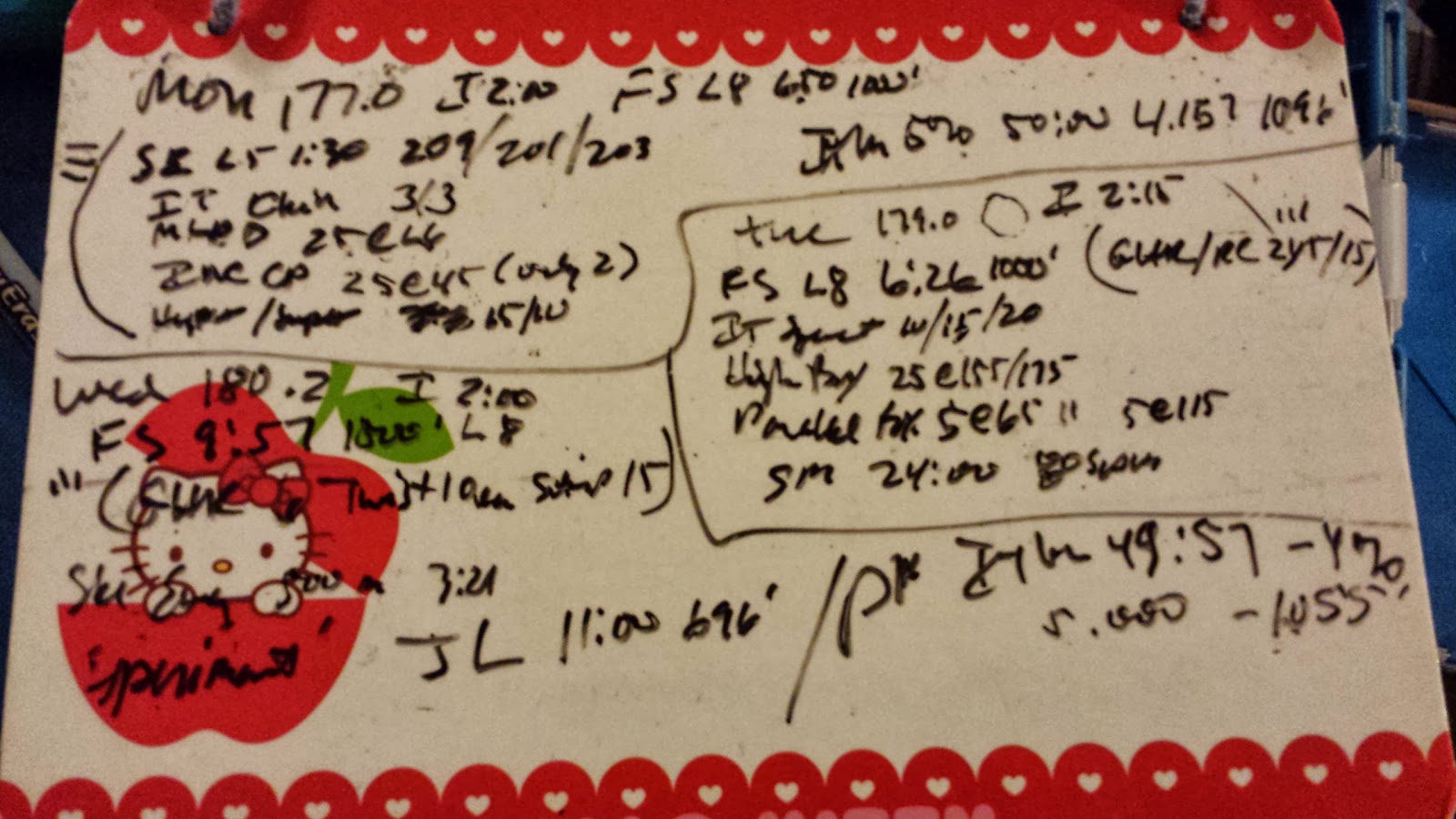
Here's my training log whiteboard from Monday through Wednesday, October 14-16.

Monday: 
Inversion: 2:00
FreeStrider Elliptical: L8 - 6:50 - 1000'
SuperSet: 3 x {
SkiErg: L5 - 1:30 - 209m, 201m, 203m
IceTool Chinup: 2 x 3 (full hang)
Machine Lat Pulldown: 25 @ L6
Incline Chest Press: 25 @ 45 lb (only 2 sets)
Back Hyperextension->Superman Plank: 15, 10 seconds
}
Incline Treadmill: [1096']
4.157 mi - 50:00 - 5% - (4.988 ave.) - [12:02 pace] - 1097.448' - (1317/21.95 vert per hour/minute)

Tuesday:
Inversion: 2:15
FreeStrider Elliptical: L8 - 6:26 - 1000'
SuperSet: 3 x {
Glute Ham Raise: 2 x 5
Roman Chair Ab Situp: 15
}
IceTool Bodyweight Squat: 10/15/20 [left/right]
High Box Squat: 25 @ 155/175 lb
Parallel Box Squat: 5 @ 65/65/115 lb
Stairmaster:
Time: 24:00
Steps/Minute: 80
Feet: 1280.00
Miles: 0.27
VAM: 975.4

Wednesday AM:
Inversion: 2:00
FreeStrider Elliptical: L8 - 9:57 - 1500'
SuperSet: 3 x {
Glute Ham Raise: 6
Roman Chair Twist: 10
Roman Chair Situp: 15
}
Ski Erg: L5 - 3:21 - 500m
Experimenting with various upper body exercises
Jacob's Ladder: 11:00 - 696'

PM:
ITM: [1055']
5.00 mi - 49:57 - 4% - (6.006 ave.) - [9:59 pace] - 1056' - (1268/21.14 vert per hour/minute)


Training Log Whiteboard for Thursday and Friday, October 17-18

Thursday:
Inversion: 2:00
FreeStrider Elliptical: L8 - 10:14 - 1500'
SuperSet: 2 x {
Glute Ham Raise: 7
Roman Chair Twist: 10
Roman Chair Situp: 10
}
Band Goodmorning: 25 ea side with purple band
IceTool Bodyweight Squat:
1-leg from parallel box - 2 x 3 ea leg
with 1 leg on 6" box - 15 ea leg
Parallel Box Squat: 5 @ 115 lb, 5 x 5 @ 65 lb
Stairmaster: Time: 4:00
Steps/Minute: 125
Feet: 333.33
Miles: 0.07
VAM: 1524.0
Incline Treadmill: [204']
.261 mi - 4:01 - 15% - (3.899 ave.) - [15:23 pace] - 206.712' - (3088/51.46 vert per hour/minute)

Friday: 
Inversion: 2:00
FreeStrider Elliptical: L8 - 13:10 - 2000'
Hyper/Superman Plank/GHR/Twist/Situp: 10 ea.
Parallel Box Squat: 6 @ 65 lb
IceTool Chinups: 5
Mahine Lat Pulldowns: 25 @ L6
Leg Extension: 10 ea @ 52.5 lb
Dumbbell Lateral Shoulder: 25 @ 10 lb ea
Romanian Deadift [Narrow]: 10 @ 135 lb

Thursday and Friday I was pretty wasted and unrecovered from all the squats and chinups I worked on. I decided to mix it up a bit and rather than do a little warmup, then weights and finish with an hour of cardio, which wasn't working very well at the time I would do my cardio first, then see if I had the energy for the weights.


Training Log Whiteboard for Saturday October 19

Saturday:
Incline Treadmill: [836']
5.285 mi - 60:00 - 3% - (5.285 ave.) - [11:21 pace] - 837.144' - (837/13.95 vert per hour/minute)
FreeStrider Elliptical: L8 - 32:22 - 5500'
SuperSet: 2 x {
Glute Ham Raise: 10
Twist: 10
Situp: 10
}
SuperSet: 5 x {
Parallel Box Squat: 5 @ 65 lb
IceTool Negative Chins: 3 [pull from standing, then 5 seconds descend to full hang]
}
Sumo Romanian Deadlifts: 5 x 5 @ 135 lb

That seemed to work out okay for me. I then drove back to Colorado where I'll be doing a lot of outdoor training at temps below 20 degrees F in the morning, on snow and ice covered dirt roads and trails. Note the frost on my chin, collar, and earbuds.